
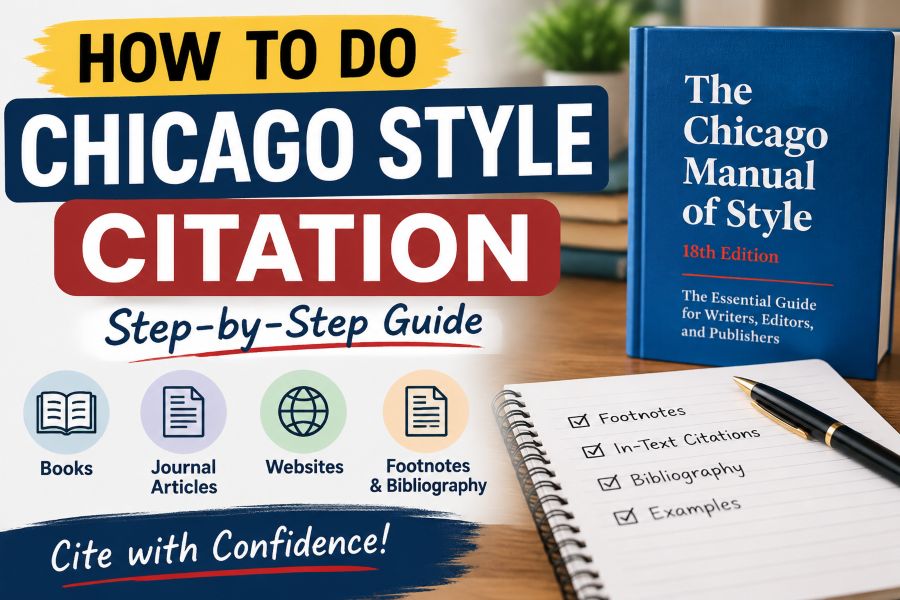
Academic writing depends on accurate citations. Whether you are writing a research paper, thesis, journal article, or university assignment, proper citation helps readers understand where your information comes from and gives credit to original authors. One of the most widely used citation systems in academic writing is Chicago style citation.
Many students struggle with Chicago style because it offers two different citation systems: Notes and Bibliography and Author-Date. Choosing the correct format and applying the rules properly can feel confusing at first. However, once you understand the structure, creating Chicago citations becomes much easier.
This guide explains how to do Chicago style citation, including in-text citations, footnotes, bibliography entries, book citations, website citations, journal citations, and common formatting rules.
What Is Chicago Style Citation?
Chicago style citation is a referencing system created by the University of Chicago Press and commonly used in history, literature, arts, and social science research. It provides guidelines for documenting sources and formatting academic papers.
The Chicago Manual of Style is currently one of the most respected style guides for academic and professional writing.
Chicago style helps writers:
- Give proper credit to original sources
- Avoid plagiarism
- Allow readers to verify information
- Organize research materials clearly
- Maintain academic credibility
Unlike some citation styles that use only one method, Chicago style provides two main approaches.
The Two Types of Chicago Style Citation
Before learning how to create citations, you need to understand the two Chicago citation systems.
1. Notes and Bibliography Style
The Notes and Bibliography system is commonly used in:
- History
- Art history
- Literature
- Philosophy
- Religious studies
This method uses:
- Footnotes or endnotes
- A bibliography page
Example:
A sentence in your paper may include a footnote number:
Digital technology has changed modern education significantly.¹
The corresponding footnote appears at the bottom of the page.
Example:
- John Smith, Digital Learning Revolution (New York: Academic Press, 2024), 45.
At the end of the paper, you include a bibliography:
Smith, John. Digital Learning Revolution. New York: Academic Press, 2024.
2. Author-Date Style
The Author-Date system is commonly used in:
- Sciences
- Social sciences
- Psychology
- Environmental studies
This system uses:
- Parenthetical citations inside the text
- Reference list at the end
Example:
Digital technology has transformed education systems worldwide (Smith 2024, 45).
Reference list:
Smith, John. 2024. Digital Learning Revolution. New York: Academic Press.
How to Do Chicago Style Footnotes
Footnotes are one of the most important parts of Chicago Notes and Bibliography style.
A footnote provides source information at the bottom of the page where the reference appears.
Basic Footnote Format
The general structure is:
Author First Name Last Name, Title of Book (Publication Location: Publisher, Year), Page Number.
Example:
- Sarah Johnson, Modern Communication Studies (Chicago: University Press, 2023), 78.
Notice that:
- The author’s name appears in normal order
- The book title is italicized
- The publication details are placed in parentheses
- The page number appears at the end
How to Cite a Book in Chicago Style
Books are among the most common sources used in academic writing.
Footnote Format
First Name Last Name, Book Title (Publisher Location: Publisher, Year), Page Number.
Example:
- Michael Brown, Understanding Digital Media (Boston: Academic Publishing, 2022), 112.
Bibliography Format
Last Name, First Name. Book Title. Publisher Location: Publisher, Year.
Example:
Brown, Michael. Understanding Digital Media. Boston: Academic Publishing, 2022.
How to Cite a Website in Chicago Style
Websites are frequently used as research sources, but they require specific formatting.
Footnote Format
Author or Organization Name, “Page Title,” Website Name, Publication Date, URL.
Example:
- National Research Institute, “The Future of Artificial Intelligence,” AI Research Center, March 15, 2025, https://example.com.
Bibliography Format
Organization Name. “Page Title.” Website Name. Publication Date. URL.
Example:
National Research Institute. “The Future of Artificial Intelligence.” AI Research Center. March 15, 2025. https://example.com.
How to Cite a Journal Article in Chicago Style
Academic journal articles require information about the author, article title, journal name, volume, issue, year, and page numbers.
Footnote Format
Author First Name Last Name, “Article Title,” Journal Name volume number, issue number (Year): page number.
Example:
- Emily Davis, “Digital Marketing Strategies,” Marketing Research Journal 15, no. 2 (2024): 50.
Bibliography Format
Last Name, First Name. “Article Title.” Journal Name volume number, issue number (Year): page range.
Example:
Davis, Emily. “Digital Marketing Strategies.” Marketing Research Journal 15, no. 2 (2024): 45–65.
How to Create Chicago Style In-Text Citations
Chicago Author-Date style uses short citations inside parentheses.
The basic format is:
(Author Last Name Year, Page Number)
Example:
Research methods continue to evolve with new technologies (Davis 2024, 25).
For sources without page numbers:
Online learning has expanded rapidly (Davis 2024).
How to Cite Multiple Authors in Chicago Style
Different numbers of authors require different formats.
Two Authors
In-text:
(Davis and Smith 2024, 50)
Bibliography:
Davis, Emily, and John Smith. Research Methods Today. Chicago: Academic Press, 2024.
Three or More Authors
In-text:
(Davis et al. 2024, 50)
Bibliography:
List all authors in the reference list.
How to Cite a Chapter in an Edited Book
Sometimes researchers use a specific chapter instead of an entire book.
Footnote Format
Chapter Author, “Chapter Title,” in Book Title, edited by Editor Name (Location: Publisher, Year), Page.
Example:
- Robert Lee, “Online Research Methods,” in Academic Writing Today, edited by Maria Green (New York: Scholar Press, 2023), 88.
Chicago Style Citation for Online Articles
Online articles are usually cited with:
- Author name
- Article title
- Website name
- Date published
- URL
Example:
- David Wilson, “How Technology Changed Education,” Education Weekly, July 10, 2025, https://example.com.
If no author exists, begin with the article title.
How to Format a Chicago Bibliography Page
The bibliography appears at the end of your paper.
Basic formatting rules:
Alphabetical Order
Arrange sources alphabetically by the author’s last name.
Example:
Brown, Michael.
Davis, Emily.
Smith, John.
Hanging Indentation
Chicago bibliography entries use hanging indentation.
Example:
Smith, John. Digital Research Methods. New York: Academic Press,
2024.
The first line starts at the margin, while additional lines are indented.
Chicago Citation vs APA Citation
Many students confuse Chicago style with APA.
Here are the main differences:
| Feature | Chicago Style | APA Style |
|---|---|---|
| Common Fields | History, Arts | Psychology, Sciences |
| Citation Method | Footnotes or Author-Date | Author-Date |
| Bibliography Name | Bibliography | References |
| Book Title Style | Italicized | Italicized |
| Date Placement | Flexible | After Author |
Chicago style offers more flexibility, especially through footnotes.
Common Chicago Citation Mistakes
Even experienced writers make citation errors. Here are some common problems.
1. Forgetting Page Numbers
When using specific information from a source, include the page number.
Incorrect:
(Smith 2024)
Correct:
(Smith 2024, 45)
2. Mixing Citation Styles
Do not combine Chicago with APA or MLA formatting.
Choose one style and follow it consistently.
3. Incorrect Author Formatting
Chicago bibliography uses:
Last Name, First Name.
Example:
Correct:
Johnson, Sarah.
Incorrect:
Sarah Johnson.
4. Missing Bibliography Entries
Every source used in your research should appear in your bibliography.
5. Incorrect Website Citations
Many writers forget publication dates or website titles.
Always include as much information as available.
Tools That Help Create Chicago Citations
Manually creating citations can take time. Several tools can help generate Chicago references:
- Citation generators
- Reference management software
- Academic writing tools
- University library resources
Popular citation management tools include:
- Zotero
- EndNote
- Mendeley
However, always review automatically generated citations because software can make formatting mistakes.
Chicago Style Citation Checklist
Before submitting your paper, check the following:
✓ Did you choose the correct Chicago system?
✓ Did you cite every borrowed idea?
✓ Are footnotes formatted correctly?
✓ Is your bibliography complete?
✓ Are book and journal titles formatted properly?
✓ Are author names written correctly?
✓ Are page numbers included where necessary?
✓ Is your citation style consistent throughout the paper?
Why Proper Chicago Citation Matters
Learning how to do Chicago style citation is more than following formatting rules. Proper citation demonstrates academic honesty and helps readers explore your research sources.
A well-cited paper:
- Builds trust with readers
- Shows strong research skills
- Prevents plagiarism
- Makes your arguments stronger
- Improves academic quality
Whether you are writing a college essay, research paper, or professional publication, mastering Chicago citation will improve the quality of your work.
Final Thoughts
Understanding how to do Chicago style citation may seem difficult at first, but the process becomes simple once you learn the basic patterns. The most important steps are choosing the correct Chicago format, creating accurate footnotes or author-date citations, and organizing your bibliography properly.
Remember that Chicago style focuses on clarity, consistency, and proper attribution. By following the guidelines for books, websites, journal articles, and other sources, you can create professional academic citations with confidence.
With practice and the right tools, Chicago citation can become a natural part of your writing process rather than a complicated requirement.

Comments
0 responsesNo comments yet. Be the first to share your thoughts.