
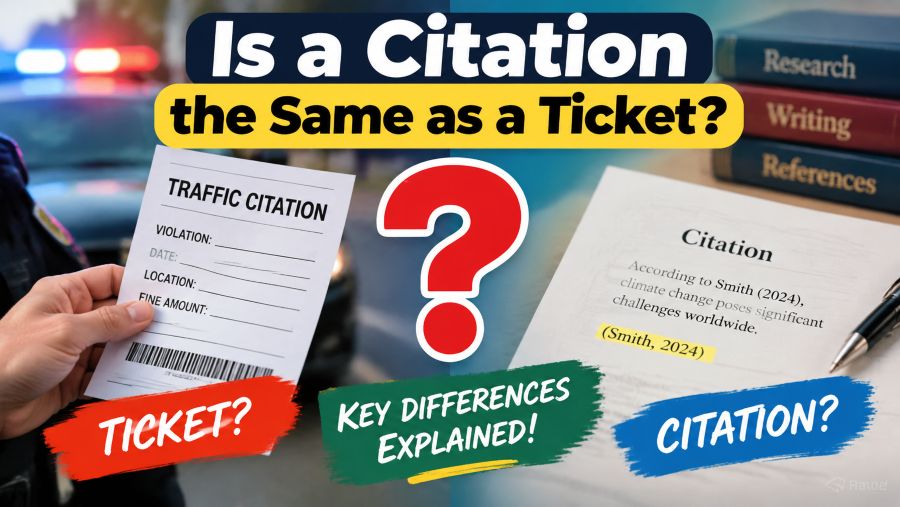
When people hear the word citation, they often think about a traffic ticket or a legal notice issued by law enforcement. This confusion is common because both terms are used in situations involving rules, laws, or violations. However, a citation and a ticket are not always the same thing.
The meaning of a citation depends on the context where it is used. In academic writing, a citation refers to giving credit to sources of information. In legal situations, a citation is an official notice that someone must respond to because of an alleged violation. A ticket is usually a type of citation related to minor offenses, such as traffic violations.
Understanding the difference between a citation and a ticket can help you avoid confusion, whether you are writing a research paper, dealing with a legal matter, or simply trying to understand terminology.
In this guide, we will explain:
- What a citation means
- What a ticket means
- Whether a citation is the same as a ticket
- The difference between legal citations and academic citations
- Examples of citations and tickets
- Common questions about citations and tickets
What Is a Citation?
A citation is an official reference or acknowledgment that points to a source, rule, law, or violation.
The word “citation” comes from the idea of citing or mentioning something. It means calling attention to a specific piece of information.
A citation can have different meanings depending on the situation.
Citation in Academic Writing
In education and research, a citation is used to show where information comes from. When writers use ideas, facts, statistics, or direct quotes from another source, they include a citation to give credit to the original author.
For example:
According to a study by Smith (2024), online learning has increased significantly.
The citation tells readers where the information came from.
Academic citations help:
- Prevent plagiarism
- Give credit to original creators
- Allow readers to verify information
- Improve credibility
- Support research claims
Common citation styles include:
- APA citation style
- MLA citation style
- Chicago citation style
- Harvard citation style
In this context, a citation has nothing to do with a ticket or legal punishment.
What Is a Legal Citation?
In legal terms, a citation is an official document or notice issued by an authority, such as a police officer or government agency.
A legal citation informs a person that they are accused of violating a law, regulation, or ordinance.
Examples include:
- Traffic citations
- Parking citations
- Court citations
- Code violation citations
A legal citation usually includes:
- The person’s name
- Date and location of the violation
- Description of the offense
- Applicable law or regulation
- Required response or court date
- Possible penalties
For example, if a driver runs a red light, a police officer may issue a traffic citation explaining the violation and the required next steps.
What Is a Ticket?
A ticket is a notice that requires someone to pay a fine or take action because of a violation.
Most commonly, people use the word “ticket” when talking about traffic violations.
Examples:
- Speeding ticket
- Parking ticket
- Red-light ticket
- Seat belt ticket
A ticket generally involves:
- A specific violation
- A financial penalty
- A deadline for payment
- Instructions for contesting the violation
For example:
A driver receives a speeding ticket for driving above the posted speed limit. The driver may need to pay a fine or appear in court.
Is a Citation the Same as a Ticket?
The short answer is:
Sometimes, but not always.
A ticket can be a type of citation, but not every citation is a ticket.
Think of it this way:
Citation = A broader term
Ticket = A specific type of citation
A traffic ticket is usually a traffic citation because it officially documents a violation. However, the word citation can also refer to many other situations.
For example:
| Situation | Citation or Ticket? |
|---|---|
| Speeding violation | Citation and ticket |
| Parking violation | Citation and ticket |
| Academic reference | Citation only |
| Court order notice | Citation, not usually called a ticket |
| Research paper source | Citation only |
So, while people often use the words interchangeably in traffic situations, they have different meanings.
Difference Between a Citation and a Ticket
Although citations and tickets are closely related, there are several differences.
1. Meaning
A citation is an official notice or reference.
A ticket is usually a penalty notice requiring payment or action.
Example:
- A police officer issues a citation for violating a traffic law.
- The citation may include a ticket amount that must be paid.
2. Usage
The word citation has broader usage.
It can be used in:
- Education
- Law
- Government
- Research
- Journalism
The word ticket is mostly associated with:
- Traffic violations
- Parking violations
- Event entry
- Transportation
3. Purpose
A citation identifies an issue or provides a reference.
A ticket usually focuses on enforcement and penalties.
For example:
An academic citation helps readers find a source.
A parking ticket informs someone about a parking violation and a fine.
4. Consequences
Academic citations have no penalties when properly used.
Legal citations may have consequences, such as:
- Fines
- Court appearances
- Points on a driving record
- Other legal actions
Are Traffic Citations and Tickets the Same?
In many places, traffic citations and tickets refer to the same thing.
When a police officer stops a driver for a violation, they may issue a traffic citation. Many people simply call this a ticket.
For example:
A person receives a citation for speeding.
The person may say:
“I got a speeding ticket.”
Both statements describe the same situation.
However, legally, “citation” is often the more formal term.
Types of Legal Citations
Legal citations can include different types of violations.
Traffic Citation
A traffic citation is issued for violations involving vehicles and driving rules.
Examples:
- Speeding
- Illegal turns
- Running stop signs
- Driving without proper registration
Parking Citation
A parking citation occurs when someone violates parking rules.
Examples:
- Parking in a no-parking zone
- Expired parking meter
- Blocking a fire lane
Court Citation
A court citation requires someone to appear before a court or respond to a legal matter.
Examples:
- Failure to appear notices
- Minor criminal offenses
- Civil violations
Code Violation Citation
Government agencies may issue citations for violating local regulations.
Examples:
- Building code violations
- Property maintenance issues
- Business license violations
What Happens After Receiving a Citation?
The next steps depend on the type of citation.
For a traffic citation, you may need to:
- Review the information carefully
- Check the payment deadline
- Pay the fine if you accept responsibility
- Request a hearing if you want to challenge it
Ignoring a citation can lead to additional problems, including:
- Increased fines
- Collection actions
- Court issues
- License problems
Always read the instructions provided with the citation.
What Happens If You Get a Ticket?
When you receive a ticket, you usually have several options.
Pay the Fine
Many minor violations allow you to pay the penalty without going to court.
Contest the Ticket
If you believe the ticket was incorrect, you may request a hearing or court appearance.
Complete a Required Program
Some areas offer options such as:
- Traffic school
- Safety courses
- Community programs
The available options depend on local laws.
Citation vs Ticket in Academic Writing
One of the biggest sources of confusion is that “citation” has a completely different meaning in academic writing.
A citation in a research paper is not a punishment.
It simply shows where information came from.
For example:
Incorrect:
Using another person’s ideas without a citation.
Correct:
Using another person’s ideas with proper citation.
Academic citations are important because they demonstrate:
- Research quality
- Honesty
- Professional writing standards
They are completely separate from legal tickets.
Why Do People Confuse Citations and Tickets?
The confusion happens because both words are connected to official records.
A legal citation:
- Records an alleged violation
- Comes from an authority
- Requires attention
A ticket:
- Records a violation
- Often includes a fine
- Requires payment or response
Since traffic citations are commonly called tickets, many people assume the words always mean the same thing.
However, the broader definition of citation includes many situations unrelated to penalties.
Examples of Citation and Ticket Differences
Example 1: Traffic Violation
A driver goes 15 miles over the speed limit.
Police issue a traffic citation.
The driver calls it a speeding ticket.
Both terms are correct.
Example 2: Research Paper
A student uses information from a book.
The student adds a citation showing the source.
This is not a ticket.
Example 3: Parking Violation
A vehicle is parked illegally.
The owner receives a parking citation.
The owner may call it a parking ticket.
Both describe the same event.
Citation vs Ticket: Quick Comparison Table
| Feature | Citation | Ticket |
|---|---|---|
| Meaning | Official notice or reference | Penalty notice |
| Used in academics | Yes | No |
| Used in law | Yes | Yes |
| Requires payment | Sometimes | Usually |
| Broader meaning | Yes | No |
| Example | Research citation | Speeding ticket |
Frequently Asked Questions About Citations and Tickets
Is a citation worse than a ticket?
Not necessarily. In traffic situations, a citation and ticket are often the same thing. The seriousness depends on the violation.
Can a citation affect my driving record?
A traffic citation may affect your driving record if it results in a conviction or is reported according to local laws.
Is a citation always a punishment?
No. Academic citations are not punishments. They simply provide references to information sources.
Can I ignore a citation?
Ignoring a legal citation can create additional problems. Always follow the instructions provided.
Why do police call tickets citations?
Because “citation” is the formal legal term for documenting a violation. “Ticket” is the common everyday term.
Final Thoughts: Citation vs Ticket
A citation is not always the same as a ticket.
The word citation has a broader meaning and can refer to references in academic writing, official legal notices, or recognition of achievements. A ticket is usually a specific type of citation related to violations, especially traffic offenses.
When discussing traffic violations, people often use citation and ticket interchangeably. However, outside of that context, the two words have very different meanings.
Understanding this difference helps you correctly interpret the word “citation” whether you are researching, writing, or dealing with a legal situation.
In simple terms:
Every ticket can be a citation, but every citation is not a ticket.



Comments
0 responsesNo comments yet. Be the first to share your thoughts.